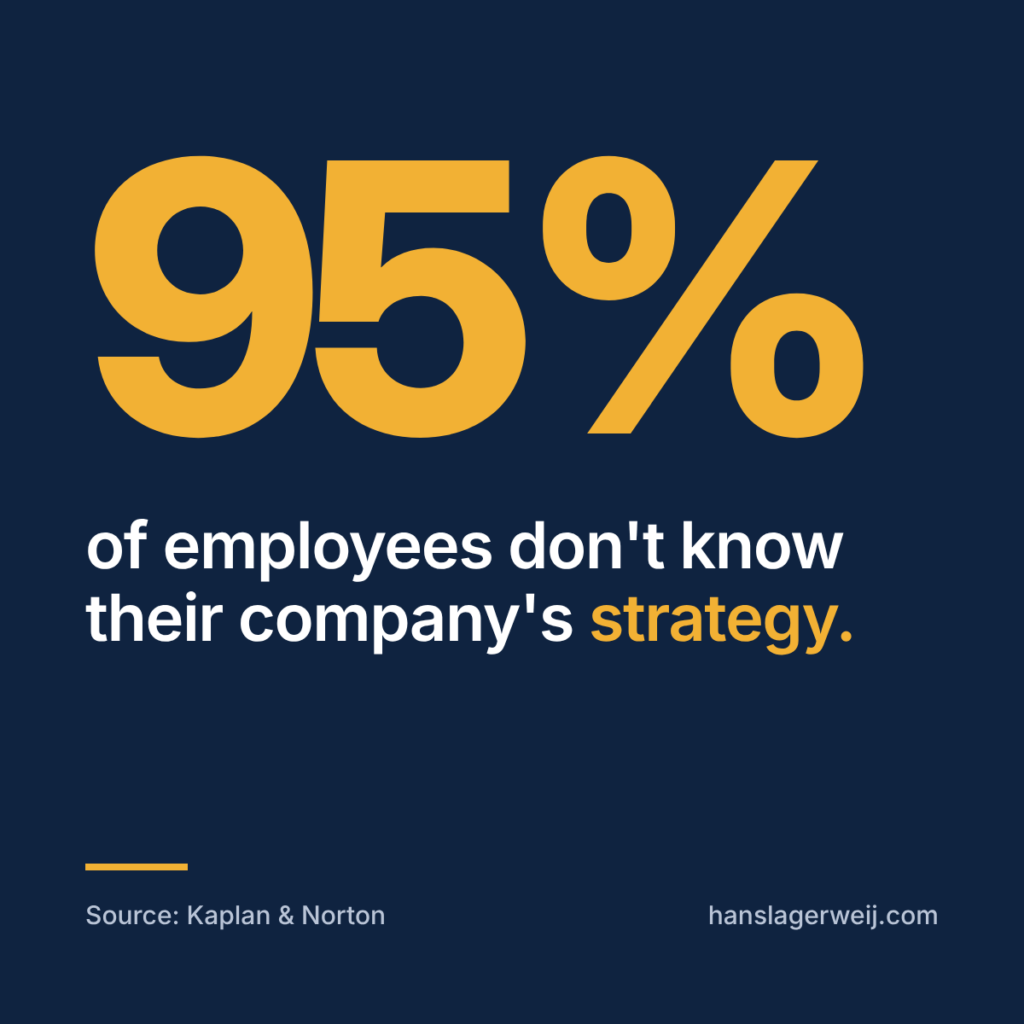
Here is one of the most uncomfortable numbers in management: research by Robert Kaplan and David Norton found that around 95% of employees do not know or understand their company’s strategy.
Think about what that means. Leaders spend months building a strategy, present it in a huge PowerPoint deck, and then wonder why nothing changes. Meanwhile, most of their teams are quietly wondering what’s for lunch.
In my experience leading companies through turnarounds and growth, the problem is rarely the quality of the strategy. It is that the strategy never makes it to the people who have to deliver it.
Why teams don’t know the strategy
1. It is too complicated
Want to turn an energetic team meeting into a room of staring zombies? Show them a 100-slide corporate strategy deck. Somewhere around slide five, everyone stops listening.
Many “brilliant” strategies fail because they are far too complex, overly academic and, frankly, boring. Strategy should not need a decoder ring. If the people on the front line cannot remember it, they cannot act on it.
2. It is announced, not shared
Most strategies are launched in a single moment: an all-hands meeting, an email from the CEO, a slide deck on the intranet. Then the organisation goes back to business as usual. A strategy that is mentioned once a year cannot compete with the daily pressure of emails, customers and targets.
3. People can’t see their part in it
Even when employees know the headline, they often cannot connect it to their own job. “Grow premium revenue by 20%” means something to the board. It means very little to a call-centre agent, a ship’s crew member or a hotel receptionist unless someone explains what it changes in their work tomorrow.
Execution beats perfection
One lesson I keep coming back to: an average plan that is well executed beats a 100-page masterpiece every single time. Bad execution eats good ideas for breakfast.
That is why I focus on execution in my book, The Why Whisperer. The 6 C’s of strategy implementation are a practical framework for turning a strategy into something teams understand, own and act on every day. One of them surprises people: celebrating wins, even small ones. A cake for the team that hit its first milestone is a legitimate management tool. It shows people that the strategy is real and that their part in it matters.
Trust is the multiplier
Teams will only carry a strategy forward if they trust the people leading it. I learned that lesson in an unusual place: sheltering from an Antarctic hurricane inside an inactive volcano. When conditions are that uncertain, a team does not follow the slide deck. It follows leaders who have been clear, honest and consistent long before the storm arrives.
The same is true in any business. Clarity builds trust, and trust is what turns a plan into action when things get difficult.
How to close the gap
If you want your team to be in the 5% who do understand the strategy, start here:
- Make it short. If you cannot explain your strategy in 30 seconds, it is probably not clear enough.
- Translate it for every team. Show each group what the strategy means for its own work and decisions.
- Repeat it relentlessly. Talk about it in weekly meetings, not just at the annual kick-off.
- Test it. Ask people to explain the strategy back to you in their own words. Their answer tells you whether you have communicated it.
- Celebrate progress. Make visible wins part of how you run the strategy.
Strategy should not be an annual headache. It should be a daily habit.
Does your team know your strategy? Try the test this week and ask them.
This article brings together several of my LinkedIn posts on strategy execution. Follow me on LinkedIn for regular updates, or subscribe to my free monthly newsletter.
Hans Lagerweij is the author of The Why Whisperer: How to Motivate and Align Teams That Get Your Strategy Done and speaks and runs workshops on strategy execution. See speaking and workshops.
New: The Why Whisperer is now also available as an audiobook on Google Play.